





Subscribe to Pittwire Today
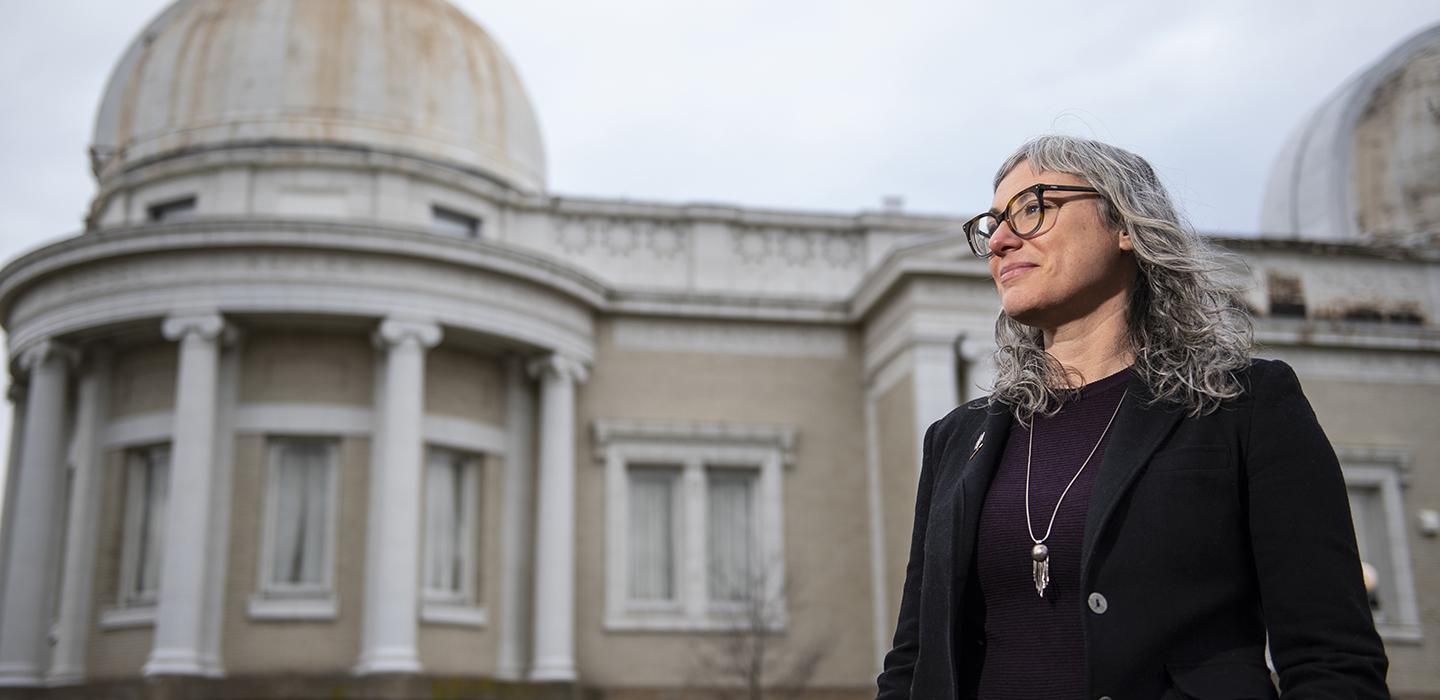
Get the most interesting and important stories from the University of Pittsburgh.The American Astronomical Society (AAS) has recognized a research team co-led by Rachel Bezanson, associate professor in the Kenneth P. Dietrich School of Arts and Sciences’ Department of Physics and Astronomy, for no less than revealing the contents of the distant universe.
The James Webb Space Telescope (JWST) collaboration will receive the 2027 Lancelot M. Berkeley – New York Community Trust Prize for Meritorious Work in Astronomy. According to the prize citation, UNCOVER — which stands for Ultradeep NIRSpec and NIRCam Observations before the Epoch of Reionization — is being honored for “combining the power of telescopes and gravitational lenses to reveal the contents of the distant universe. Through spectroscopic studies, the team has discovered galaxies at cosmic dawn, including large populations of luminous galaxies and supermassive black holes in the early universe.”
Bezanson began working on the proposal that would ultimately lead to this work when she first joined Pitt nine years ago. “I feel unbelievably lucky to be doing science and using this amazing public observatory, which is a testament to all of the people involved over decades,” she said.
The JWST has opened the door to a spectacular range of observations that were previously out of reach. UNCOVER is a Cycle 1 JWST Treasury program that conducted ultradeep imaging and spectroscopy of and around Abell 2744, a massive group of galaxies also known as “Pandora’s Cluster.”
The large mass of this cluster causes it to act as a powerful magnifying glass, bending the light from faraway background galaxies. Lengthy dedicated imaging of this gravitational lens and deep spectroscopy of sources identified by JWST have enabled the project team to identify and characterize distant galaxies from some of the earliest stages of the universe.
“We tried to — and I think succeeded in — designing a program that facilitated an exploration of the unknown-unknowns,” Bezanson said. “We wanted to narrow in on finding and characterizing the things that didn’t quite make sense or look right that were previously invisible.”
This year’s prize recognizes the UNCOVER team for three recent articles published in AAS’s Astrophysical Journal. The first and the second present an overview of the UNCOVER project, summarize its science goals, and characterize the initial imaging and final spectroscopy.
The third introduces a key result from the project: evidence that the population of faint, compact “little red dots” seen by JWST in the early universe is dominated by actively accreting black holes rather than just dusty star-forming galaxies. The team showed that these reddened, active galactic nuclei are far more numerous at high redshifts than previously recognized.
“UNCOVER has fundamentally expanded our view of the early universe, revealing a population of distant galaxies and growing black holes that was largely hidden from previous observations,” AAS Senior Vice President Ted Bergin said in a statement. “Its discoveries challenge our understanding of how the cosmos took shape while setting a powerful example of how large-scale collaboration can advance astronomy.”
Bezanson, too, cited the international collaboration of more than 50 people as one reason UNCOVER was such a success.
“That’s why this award — given to the team, not a figurehead — is so rewarding and wonderful,” she said. “Much of the work was done by exceptional junior postdoctoral researchers and students, who often get passed over when awards are given for those in leadership roles. I hope (and think) that our team knows how much I and co-PI Ivo Labbe (of Swinburne University of Technology) appreciate them.
“But to know that the community is celebrating the team’s work couldn’t be better.”
Photography by Aimee Obidzinski