






Subscribe to Pittwire Today
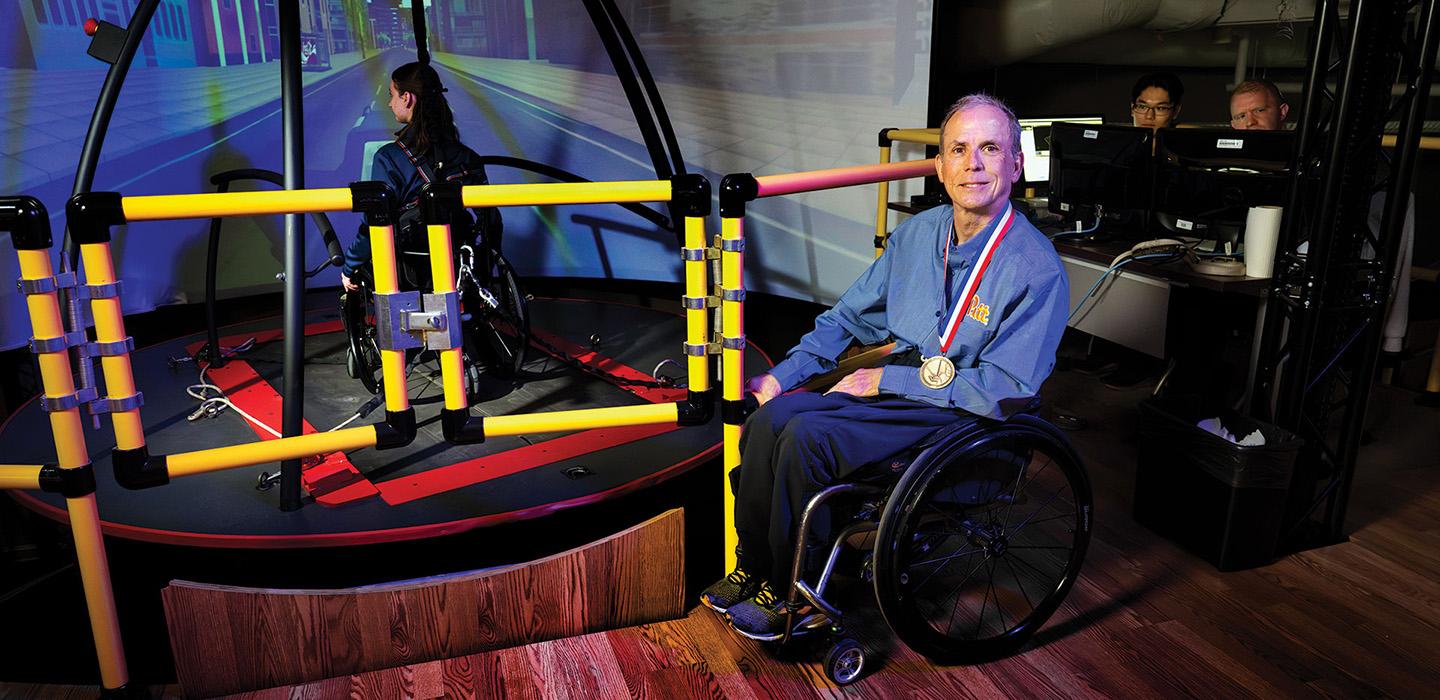
Get the most interesting and important stories from the University of Pittsburgh.Rory Cooper, director of the Human Engineering Research Laboratories (HERL) and Distinguished Professor of Rehabilitation Science and Technology at the University of Pittsburgh, deserves his flowers.
And there are many to point to.
Cooper and his team at HERL are designing a wheelchair that can navigate curbs, lift beverages and generally give people with disabilities more independence and confidence to perform day-to-day tasks like buying a cup of coffee. The project is funded by a $41.5 million award from the Advanced Research Projects Agency for Health, and it’s the first time Pitt has been tapped to lead a project by the U.S. Department of Health and Human Services agency.
Also recently, Cooper won the King Salman International Award for Disability Research for technological applications in disability. The award “honors individuals whose work has made a significant impact on advancing knowledge, prevention, rehabilitation and quality of life for persons with disabilities.” And, for his work establishing and leading HERL, Cooper was named to Forbes’ list of most successful living veterans in honor of the nation’s semiquincentennial this year.
Here are just a few more accolades honoring Cooper’s transformative work in biomedical engineering:
- Spoke at the United Nations’ AI for Good Global Summit in Geneva, Switzerland, in 2025.
- Elected to the National Academy of Engineering Class of 2024
- Awarded the National Medal of Technology and Innovation, the nation’s highest honor for technological achievement, in 2023
- Inducted into National Inventors Hall of Fame in 2023
- Named to the United States Olympians and Paralympians Association’s Executive Committee in 2024
- Joined the board of directors of the Army Heritage Center Foundation
That doesn’t even include the Rory Cooper trading cards.
For more than 30 years, the assistant vice chancellor for research for STEM-health sciences collaborations has been using applied science to solve common problems faced by disabled veterans and other wheelchair users, both groups in which he counts himself. Among the innovations emerging from his research are a hand-rim for manual wheelchairs that eases the stress of moving and stopping and a digital joystick for electric-powered wheelchairs that compensates for hand tremors.
His work is among the finest examples of how Pitt’s researchers are pioneering new fields of technology and entrepreneurship that push the edge of what’s possible.
Photography by Tom Altany