



Space
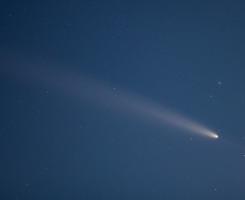
Look to the western skies this month to see a once-in-a-lifetime comet
We talked with Edward Potosky about how to see Tsuchinshan-ATLAS, which won’t be back for 80,000 years.
Ian Flynn’s research on Mars’ lava buildup was highlighted by the journal Icarus
The study validated findings of spatter cones by comparing the extraterrestrial structures to the aftermath of an Earth volcano.
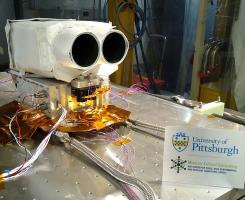
A new Pitt class is taking engineering to greater heights
Space engineering is just the first Swanson School course in a new effort to train students for the growing demand in aerospace and other industries.
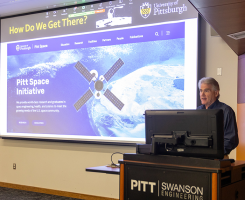
Pitt Space is bringing researchers together at the start of a new space race
The new initiative will focus on research and workforce development in space engineering, biomedicine and science.
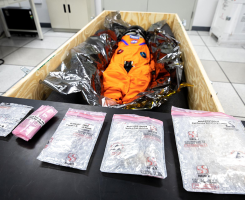
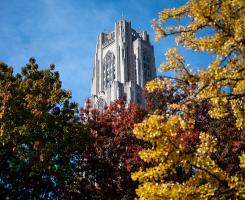
A moon tree is taking root near Pitt’s historic Allegheny Observatory
A seed that circled the moon with NASA will be planted in Riverview Park. Celebrate its arrival on Oct. 6.
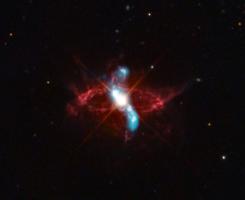
A rare stellar explosion will soon reveal a ‘new’ star. Here’s how to see it.
Visible with the naked eye, the nova will be the brightest one most people ever see, says Pitt astronomer Carlos Badenes.

The first Dark Energy Spectroscopic Instrument results made the most precise measurement yet of our expanding universe
Using the DESI, researchers have made the largest 3D map of our universe and world-leading measurements of dark energy, the mysterious cause of its accelerating expansion.
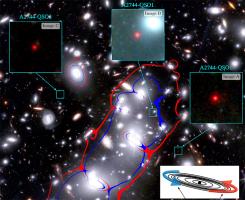
Rachel Bezanson was on a team of astronomers that detected a black hole in the early universe
Their findings on the supermassive red mass, which combined James Webb Space Telescope observations with gravitational lensing, were published in Nature.

Pitt research on small galaxies was published in Nature
Their findings from James Webb Space Telescope observations show they may be responsible for opening the universe to light.

Solved at Pitt: What are Saturn’s rings made of?
Pitt researchers have made many leaps in their fields — here's how Professor James Keeler settled the debate about the planet at the University's own Allegheny Observatory.