



Space
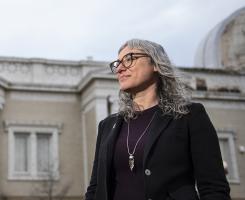
Pitt astronomers will be among the first to use the latest and greatest NASA telescope
Four faculty members are on teams that will point the James Webb Space Telescope at distant objects, galactic winds and exploding stars.

Pitt team finishes third in NASA challenge
Pitt's VULCAN prototype received recognition for the Most Innovative Concept and Lightest System Mass.

Engineering team studies new architecture for customized space computing
Students at Pitt’s NSF Center for Space, High-performance and Resilient Computing received the Best Paper Award for Research in Space Computing at the 2021 IEEE Space Computing Conference.

Alumna chases opportunities at NASA
Stephanie Jiménez (A&S ’21) put her Pitt degree to work this summer as an intern for a NASA program that addresses environmental issues.

Signs of Life
As NASA’s Perseverance rover headed for Mars, a Pitt faculty member and an alumna had much more than a passing interest.

Art and engineering collide
Mechanical engineering student Aarti Patel found inspiration in outer space during an artistic internship at NASA this spring.

Chemist’s tech makes it to Mars
Sanford Asher has spent his career studying UV Raman spectroscopy, which uses ultraviolet light to excite molecules and determine the basic components of matter. Now, he’s using it to look for life on Mars.

Exploring regenerative medicine in microgravity — aboard the International Space Station
The question for regenerative medicine research is “‘What can we do in space that we can't do on Earth that makes a difference?’" said William Wagner, director of the McGowan Institute, which has joined with the International Space Station U.S. National Laboratory to look for answers. "That's a pretty exciting question, because it's currently unanswered."

Pitt professor helped humanity make ‘one small step,’ keeps space research going
As a postdoctoral researcher, Bruce Hapke helped NASA determine the consistency of the moon’s soil, which helped engineers create the proper boots, rovers and wheeled equipment for the Apollo 11 landing, which happened 50 years ago this Saturday. Hapke and others at Pitt have helped build on a legacy of space research.

Student helps NASA thwart microbial hitchhikers on future Mars missions
Emily Klonicki spent the summer in a NASA lab helping to develop filters to keep microbes from contaminating Mars.